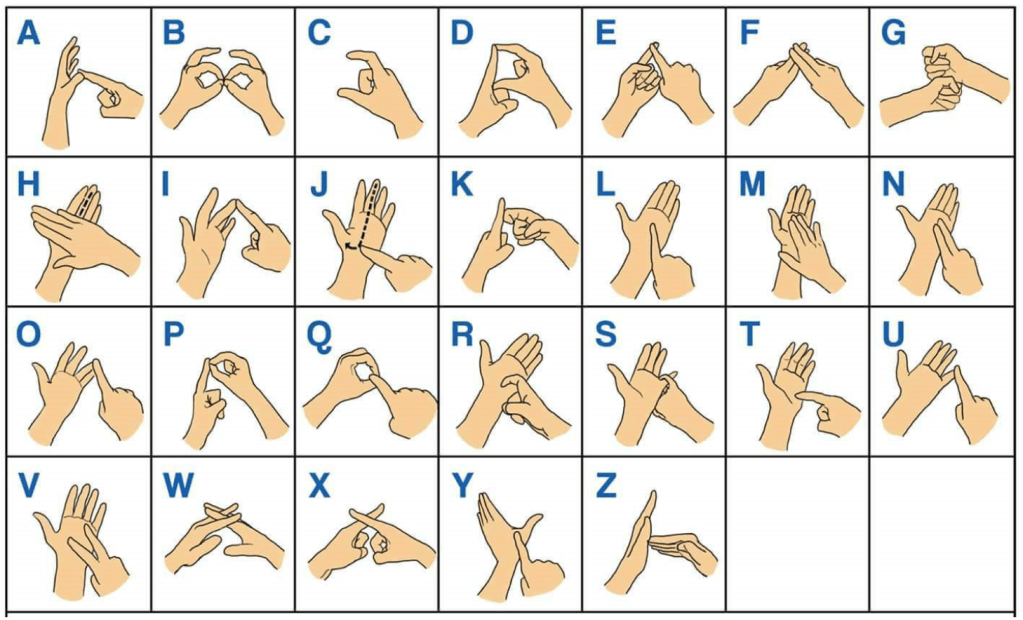
Here’s a list of my top 5 most common myths that I’ve come across when learning BSL over the last few years. (Please don’t take anything too seriously! This is just to educate, not yell at people)
- BRITISH SIGN LANGUAGE = ENGLISH SIGN LANGUAGE
Many people believe that BSL is simply gestured English spoken language, rather than its own independent language. No, everyone, throwing crude gestures at your mates across the room is not the same as BSL! The added word “British” is only there because it’s the version of sign language used in Britain – it actually has nothing to do with English. It differs in grammar, sentence structure, terms of expression, and even sense of humour. To explain it best, I’ll steal a teaching method from one of the BSL teachers from my course:
“In English, you’d say that ‘a man walked over a bridge’, but in sign language, if you think about making something physical, you can’t put the man first, because there’s nothing for him to stand on. The bridge needs to exist first, and then you can say that the man walked over it, otherwise he just falls down! So, therefore, it would be ‘there’s a bridge, and a man walked over it’, roughly.”
Please don’t directly quote me on that, he would definitely explain it in a better manner. It’s the easiest way for me to show how BSL sentences differ from English ones. It’s as different to English as Spanish is, why? Because they’re different languages.
2. ALL DEAF PEOPLE KNOW/USE SIGN LANGUAGE
Such a bold, generalising, and incorrect statement! There are so many different ways to communicate outside of using sign language. Lipreading, written communication, cued speech, the list goes on. Especially with the advances in modern technology, and the rise of oralism in schools for Deaf children, sign language may in fact be on the decline. I know several Deaf people who don’t use sign language! Asking someone to learn a whole new language, when they already have a communication system that works for them is definitely a big ask, and probably won’t go down too well…
Think about it like this: that older family member who uses hearing aids because they have age-related hearing loss? They’re deaf! Do they use sign language? No, probably not, but that’s also a generalising statement! Essentially, some people use sign language, some people don’t, it’s all about what’s most comfortable for them. Some people don’t because they don’t have the motor skills to be able to, some people don’t because they grew up lipreading and speaking English. The reason doesn’t matter, but your assumptions do.
3. UNIVERSAL SIGN LANGUAGE?
I see a lot of stuff online about people thinking that – most commonly – ASL is universal, and people making videos in BSL are “signing wrong”. There is no “universal sign language”! Even in the same country, people sign things differently! You could go 20 minutes down the road, and someone could sign something completely differently to how you do. That’s all to do with history and different communities coming up with their own signs for things in their own areas.
Maybe the closest thing that exists is International Sign Language (IS – not to be confused with ISL, Irish Sign Language), which combines local signs with mutually understood visual concepts and mimes/gestures in order to communicate. It’s not a fully formed language, unlike BSL, ASL, etc, and even then, not everyone knows it.
Sign language develops in variation due to different respective communities, for example, even though Australia, the USA, and England all speak English, primarily, they all have their own sign language.
4. BSL / MAKATON / SSE – THEY’RE ALL THE SAME
When a lot of people hear about sign language for the first time, at least in my experience, they tend to talk about Mr. Tumble, from CBeebies’ ‘Something Special’, or song signing videos on social media. It’s very common that they confuse Makaton and SSE with BSL, and I can see why! I also used to make that same mistake – they all use variations of signing, that – without being told – can look like they’re part of the same language system.
Makaton: Tends to be considered “baby sign”. It’s not a formal sign language, and combines gestures, basic signs, and speech to form communication. It’s largely used with young children or those with communication difficulties combined with motor skill difficulties so that they may struggle to use BSL. It’s more accessible to use than BSL, since the signs are simple, and there’s no rigid grammatical structure.
SSE: “Sign Supported English”. This is a form of MCE (Manually-Coded English). It uses signs from BSL but follows English sentence structure and grammar. It’s also usually combined with spoken language at the same time as signing, which is why it’s most commonly seen in those song signing TikToks that you may know about. This is not BSL! SSE it not its own language, it is a communication tool.
5. IF YOU KNOW THE ALPHABET, THAT’S ENOUGH
Fingerspelling makes up the foundation of a jumping-off point when starting to learn BSL. It’s very important, since if you don’t know a sign, you can fingerspell the word in order to get the point across. But, in my experience, a lot of Deaf people don’t really like fingerspelling! It takes a long time, it can be difficult to keep up with, and it’s kind of just a pain in general. I see a lot of people saying “Oh, I know sign language!” and then fingerspelling the alphabet. Apply this same logic to any spoken language, and it sounds a bit ridiculous. I would much rather someone know basic signs, rather than just the alphabet! If I had a penny for every time someone signed the alphabet to me, I wouldn’t be rich, but I’d have more money than I do now.
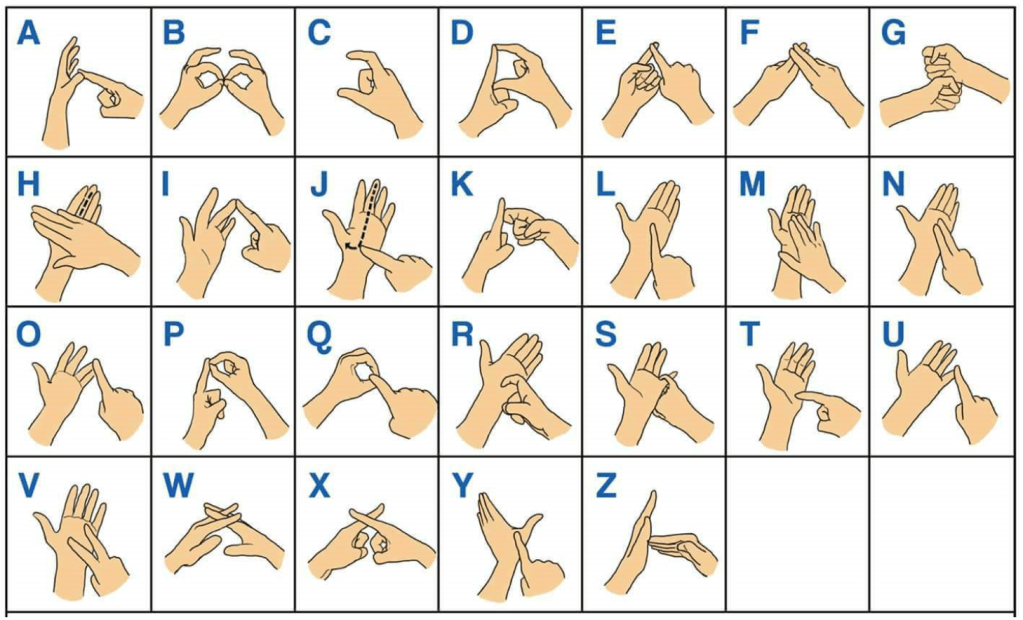
Image taken from https://deafaction.org/bsl-courses/learn-the-bsl-alphabet/


Leave a comment